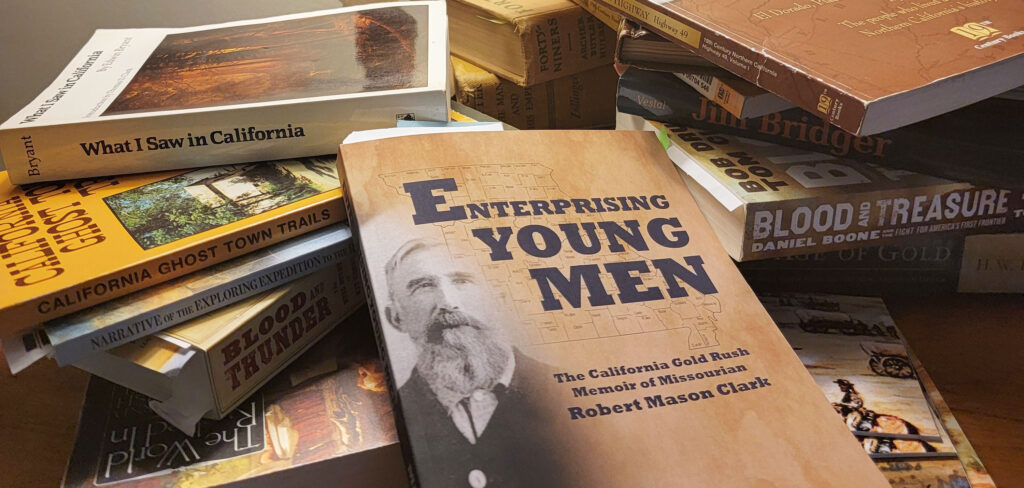
Hundreds of 1800s gold rush diaries and journals have been published that shed light on many aspects of the world-changing events of that time. Thousands of letters shared in community newspapers during that era are now included in libraries or are found on family heritage websites. The following books offer a greater understanding of that pivotal time.
The Rush [Little, Brown & Co., 2014], by Edward Dolnick. The author’s history of the gold rush uses many firsthand accounts by miners, from letters, diaries, and government documents. Very engaging to read, with difficult encounters and conditions not sugar-coated.
Forty-Niners [Little, Brown & Co, 1949], by Archer B. Hulbert. If you can get a copy of this “chronicle of the California Trail,” you will find cartoons, sketches, poems, songs, interspersed in a diary that was concocted from actual gold rush era sources. Hulbert tries to create a “typical” argonaut experience, with the protagonist departing from Independence, Missouri, and mining in Placerville (also known as Hangtown). This thorough project includes a sizeable bibliography of sources.
The Rush for Riches [University of California Press, 1999] and The World Rushed In [University of Oklahoma Press, 2002] are two books by renowned gold rush historian J. S. Holliday. The first tells how the gold rush era created the state of California, and the latter uses 518 diaries and letters to create a highly detailed account of the California gold rush experiences, with many maps.
The Age of Gold [Anchor Books, 2002] by H. W. Brands. This notable historian’s work presents history with a scholarly eye and tells the “background story” about much of the Westward Expansion’s events. With a focus on the political and economic conditions of the United States at various moments of the gold rush era, Brands reveals America’s sociological drivers.
Share your thoughts and experiences if you do read any of these suggestions, and please recommend your own!
Happy reading! — M. K. Clark